


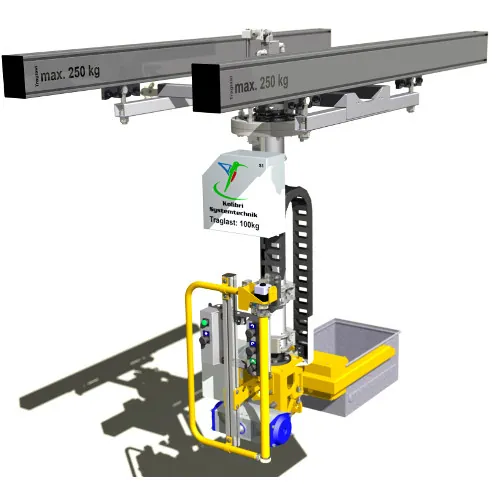
Material handling

Lifting aids that fit the task – not the catalogue.

A lifting aid that is slower than the human hand ends up in a corner within three weeks. That is why every selection starts with the task: what is lifted, how often, where to and how precisely. This page sorts the types, names the figures that decide, and leads to the areas of use.

Equipment
8
Use cases
6
Makes
all
01

What a lifting aid has to do

With a lifting aid, the person guides the load and the device carries it. That sets it apart from a crane, which is operated, and from a robot, which works on its own. The glossary explains exactly what the term covers; this page is about which lifting aid belongs at which workstation.

An ergonomic lifting aid has to do two things at once: take the weight off the worker and not slow the work down. The second is often underestimated. If picking up a part means hooking on, finding a button and waiting for the device, people soon go back to lifting by hand – and the investment has changed nothing.

02

The main types

Industrial lifting aids differ mainly in how the load is suspended and whether the device merely balances its weight or also takes up moments. That gives six basic forms, which can often be combined:

  • Rope balancer: the load hangs on a rope and floats; the operator guides it by hand. Fast and sensitive, but only for loads hanging straight below the rope.
  • Lifting column: a rigid axis raises and lowers. It takes more moment than a rope and is suited to precise placing.
  • Articulated-arm manipulator: a rigid jointed arm holds loads gripped off-centre and reaches into machines.
  • Vacuum lifter: a lifting attachment that grips with suction pads – on a balancer, a lifting column or a chain hoist.
  • Jib crane and rail system: these are the supporting structure. A jib crane covers a circle, a rail system a rectangle.
  • Mobile units: a column on a wheeled base, for places of use that change.
03

Four figures decide the selection

The first is the load – including the gripper. A vacuum gripper for large panels can use up a considerable share of the rated capacity on its own. The second is the moment: if the load is gripped off-centre, rotated or turned over, the device has to take up that moment. A rope cannot.

The third is the cycle. How many lifts per shift, and how much time is there for one pick? That decides whether a balancer is enough or whether a fast-gripping system is needed. The fourth is the working area: from where to where the load moves, what is in the way and how high the room is. Area and height determine the supporting structure.

Only once these four figures are known is it worth opening the catalogue. Our calculator gives a first estimate of rated capacity and load moment.

04

Pneumatic or electric

A pneumatic lifting aid balances the load with compressed air, via a cylinder or a rope drum. Its advantage is feel: the load floats, and the operator guides it by hand to where it belongs. It needs a compressed-air supply that delivers enough volume at the required quality – 6 bar operating pressure for our balancers and lifting columns.

Electric lifting aids, such as an articulated arm with chain hoist, lift at the push of a button. They have the edge where there is no compressed air, where longer strokes are needed, or where the movement should be steady rather than sensitive. Which drive fits is rarely a matter of taste but of the task – our guide on pneumatic and electric drives goes through it in detail.

05

When a lifting aid is required

In Germany there is no fixed weight above which a lifting aid becomes mandatory. What counts is the Manual Handling Ordinance: the employer assesses the risk of lifting and carrying and takes measures if it is too high. The usual tool is the Key Indicator Method of the Federal Institute for Occupational Safety and Health (BAuA). Besides weight, it considers frequency, posture and working conditions.

Measures follow a hierarchy: technical before organisational before personal. Back training therefore does not replace a lifting aid where the strain can be reduced technically. Our guides on ergonomics and on the risk assessment describe the procedure and the thresholds the method uses.

06

What we take on

We start at the workstation: recording load, cycle, paths and postures – as a workplace analysis with a Key Indicator Method rating if required. From that comes the design: type, supporting structure, drive and the gripper, which we design and build for your workpiece where needed. Installation, commissioning and instruction are part of it.

Combining a device and a gripper raises the question of whether a new machine is created under the Machinery Directive – from 20 January 2027 the Machinery Regulation (EU) 2023/1230. We clarify that and supply the documents. After commissioning we inspect and maintain the equipment, including units from other manufacturers.

Overview

Which lifting aid for which task

Task Obvious type Typical gripper What matters
Moving cartons at the packing station Rope balancer on a rail system Vacuum area gripper Pick time and cycle
Palletising sacks Rope or articulated rope unit Clamp or needle gripper Pick height and layer pattern
Loading a part into a machine Articulated-arm manipulator Mechanical gripper Off-centre load, moment
Lifting vertically and placing precisely Lifting column Mandrel or expanding gripper Sensitivity, stroke
Heavy parts over a large area Articulated arm with chain hoist Hook, spreader beam Reach, electric drive
Place of use changes Mobile unit Depends on the workpiece Stability, floor
Frequently asked questions

Frequently asked questions about Lifting aids

How much does a lifting aid cost?

That depends less on the device than on the gripper and the supporting structure. A balancer on an existing column is a different job from a rail system over an entire packing line with a custom gripper. We therefore do not quote a flat price; after a survey at the workstation you receive an offer that shows each item separately.

Above what weight is a lifting aid needed?

In Germany there is no statutory weight limit. Whether measures are needed follows from the risk assessment under the Manual Handling Ordinance, usually using the Key Indicator Method. Moderate weights can score high if they are lifted very often or in awkward postures.

What is the difference between a balancer and a manipulator?

A balancer compensates the weight; the load hangs freely on the rope. A manipulator has a rigid arm and holds the load even when it is gripped off-centre or rotated. The balancer is faster, the manipulator can do more. Our guide “Manipulator or balancer?” compares the two in detail.

Do lifting aids need regular inspection?

Yes. Lifting aids are work equipment and are inspected periodically; the operator sets the interval in the risk assessment. For hoists and pulling devices, German DGUV Regulation 54 requires an inspection at least once a year. Loose lifting attachments such as vacuum or clamp grippers are inspected as well. We do this for equipment from other manufacturers too.

Can an existing lifting aid be adapted to a new task?

Often, yes – with a new gripper, a longer rail or a different control. First it has to be checked whether capacity and moment are sufficient for the new task and whether the modification counts as substantial. We check both before we modify anything.

Do you build grippers for our workpieces?

Yes. The gripper often decides success more than the device itself. We design grippers for workpieces for which nothing suitable is available off the shelf – from a drawing, a sample or a survey on site.

Contact

Describe the load and the task to us.

Weight, dimensions, gripping point and how often a day – that is all a first proposal needs. The rest we settle at the workstation.

Reach Entracon

How can we help?

Chat is not staffed right now. We are back for you today from 08:00. Just request a call-back – we'll get back to you.
Send an e-mail info@entracon.de
Or call us directly +49 234 5414010