


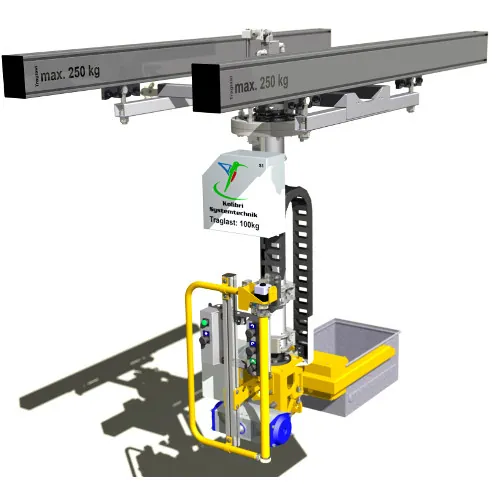
Lifting aids

Lifting cartons without carrying them: lifting aids and carton grippers.

A carton is easy to describe and hard to grip. The board yields, the contents are unknown, and sometimes the lid cannot even carry itself. That is why every lifting aid for cartons starts with the gripper – the device follows.

Equipment
4
Use cases
3
Makes
all
01

The carton is the hardest simple workpiece

A steel part has a fixed shape, a known weight and a centre of gravity that stays where it is. A carton has none of these for certain. Its contents may shift, its weight may vary from shipment to shipment, and its surface may be covered with film, labels or tape. And the board itself lets air through.

It follows that there is no carton gripper for everything. Which one fits depends on how the cartons are made, how they arrive and where they go.

02

Vacuum area grippers: fast, but not for every carton

The most common gripper for cartons is an area gripper that grips the lid from above. It is fast, because the operator only has to place it and lift. Two conditions have to be met, though: the lid has to carry the weight of the contents, and the vacuum generation has to compensate for the air flowing in through the board. Porous corrugated board therefore needs vacuum generation with considerably more flow than a smooth, sealed surface.

Separately switchable zones allow small and large formats to be gripped with the same gripper. Our guide on sizing vacuum lifters describes how holding force and reserve are calculated.

03

Clamp and fork grippers: when the lid will not carry

Open cartons, cartons with a weak lid or with heavy, loose contents are better gripped from the side or from below. A clamp gripper holds the carton on two opposite sides; a fork gripper moves underneath it. Both need space: a gap next to the carton or access to its underside, for example on a roller conveyor with a cut-out.

They are somewhat slower than a suction gripper, but independent of whatever is stuck to the surface. In practice the two principles are often combined: suction for the normal case, clamping or forks for the exceptions.

04

Parcel grippers for mixed shipments

Where parcels of different sizes arrive – in parcel handling, returns, or goods-in with many suppliers – a parcel gripper has to adapt. That can be done with adjustable clamping jaws, suction zones or interchangeable grippers with quick couplings. An analysis of the formats shows which route is right: if a few sizes make up most of the volume, a gripper tailored to them pays off. With a very wide spread, adjustability matters more than the last bit of speed.

05

Where the cartons come from and where they go

On a pallet, the pick height changes with every layer. The stroke of the lifting aid therefore has to reach from the bottom to the top layer, and the structure has to cover the whole pallet and the set-down point beside it. From conveyor to pallet, from rack to packing table: the path decides whether a jib crane is enough or a rail system is needed.

Our application “Moving eight hundred cartons per shift” shows what this looks like at a high-volume dispatch station. This page covers the selection in general; that one describes a specific case.

06

What the device has to carry

The design load is never the carton alone. An area gripper with vacuum generation, valves and handle has its own weight, which comes off the device’s rated capacity. Our Skyline rope balancers are rated for 60 and 100 kilograms including the tool; the I-GO lifting columns, depending on the model, for 60 to 400 kilograms. A balancer is often enough for cartons; where heavy containers or a heavy gripper are involved, the lifting column is the safe choice.

Overview

Carton grippers compared

Gripper Suited to Advantage Limit
Vacuum area gripper Closed cartons with a load-bearing lid Fast, one grip from above Porous board, weak lid, loose film
Area gripper with zones Several formats No changeover between sizes More effort in the vacuum system
Clamp gripper Open or soft cartons Independent of the surface Needs space at the sides
Fork gripper Heavy or delicate contents Carries from below Needs access to the underside
Interchangeable gripper Very mixed shipments The right gripper for each format Changing takes time
Frequently asked questions

Frequently asked questions about Cartons and parcels

Which gripper is best for cartons?

For closed cartons with a load-bearing lid, usually a vacuum area gripper, because it is the fastest. For open cartons or heavy, loose contents, a clamp or fork gripper is safer. With mixed formats, suction zones or interchangeable grippers help.

Why does corrugated board need more suction?

Because air flows in through the board. The vacuum generation has to compensate for this leakage continuously to hold the vacuum. That requires more flow than with a sealed surface.

What happens if the carton lid gives way?

Then the gripper holds the lid but not necessarily the contents. That is why it is checked beforehand whether the lid can carry the weight. Where that is not certain, the carton is clamped from the side or carried from below.

Is a rope balancer enough for lifting cartons?

For most cartons, yes, as long as carton and gripper together stay below the rated capacity and the load hangs straight below the rope. With heavy containers or heavy grippers, a lifting column is the better choice.

Can cartons be picked directly from the pallet?

Yes, if the stroke reaches from the bottom to the top layer and the structure covers the whole pallet. With tightly packed layers, a gripper from above is usually simpler than a clamp gripper that needs space at the sides.

Contact

Describe the load and the task to us.

Weight, dimensions, gripping point and how often a day – that is all a first proposal needs. The rest we settle at the workstation.

Reach Entracon

How can we help?

Chat is not staffed right now. We are back for you today from 08:00. Just request a call-back – we'll get back to you.
Send an e-mail info@entracon.de
Or call us directly +49 234 5414010