


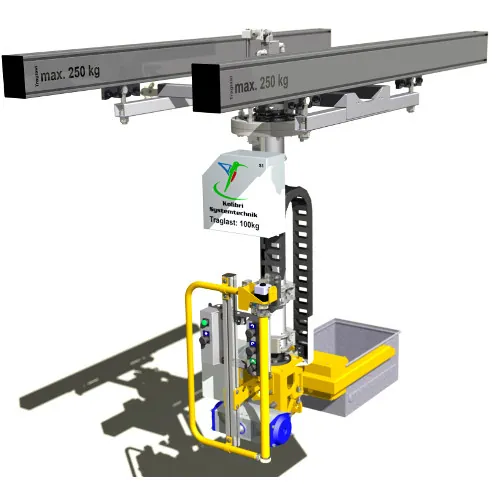
Lifting aids

Lifting aids in production: the load where the machine needs it.

On the shop floor it is not enough to lift a part. It has to go into a chuck, against a stop, through a guard door into the working area. A lifting aid for production is therefore chosen by the position it has to reach.

Equipment
5
Use cases
6
Makes
all
01

In production, position is what counts

When loading a machine, the movement does not end on a shelf but at a precise point: in the chuck of a lathe, on the locators of a fixture, against the stop of a saw. The operator has to do more than lift – the load must be aligned, rotated and set down gently.

A rope can only do that while the load hangs straight below it. As soon as it is guided into a working area, it is off-centre – and then a lifting aid with a rigid arm is needed to take up the resulting moment.

02

Reach and moment

The moment is load multiplied by distance. A part held half a metre in front of the gripping point creates a moment that a device with the same rated capacity cannot necessarily take. Every serious design therefore states the permissible load moment alongside the capacity.

Articulated-arm manipulators such as the Elbow, with a radius of around 2.4 metres, are built for such tasks. For screwdrivers whose reaction torque the operator would otherwise absorb with the wrist, there are torque arms. Our calculator gives a first estimate of capacity and load moment; it does not replace the verification.

03

Sheets and panels

Flat workpieces are usually gripped by vacuum. With large formats, deflection comes into play: a thin panel held only in the middle sags at the edges and can come away from the pad. A spreader beam with several pads distributed over the surface solves this.

At a press brake, the sheet also has to be turned over, often several times per part. The gripper then needs a rotating or turning unit that holds the sheet while it goes from underside to top. Our applications on turning sheets and loading a CNC with panels show the details.

04

Tool and set-up changes

Some lifts are rare but heavy: an injection mould, a roll, a coil. Production often waits for the overhead crane, which is needed elsewhere at that moment. Every minute of waiting lengthens set-up time.

A dedicated lifting aid at the machine makes the change independent of the crane. Whether that pays off depends on how often set-ups happen and what an hour of downtime costs – our guide “Overhead crane or own device?” works through the trade-off.

05

Removing parts: hot, oily, sharp-edged

Parts removed from a press, an injection moulding machine or a machining centre are rarely clean and dry. They may be warm, wet with coolant or sharp-edged. This mainly affects the gripper: vacuum holds less well on oily surfaces, pads of an unsuitable material age faster on warm parts, and edges can damage suction plates. A mechanical gripper is often the more robust choice here.

06

The interface with the machine

Where a lifting aid reaches into a machine’s working area, it touches that machine’s safety concept. Guard doors, light curtains and enabling signals have to work together so that nobody reaches into a running movement. If the lifting aid is fixed to the machine frame, the frame has to take the additional forces.

Both belong in the risk assessment. We therefore plan the lifting aid with the machine it serves in view, and clarify with the operator whether the combination amounts to a substantial modification.

Overview

Production tasks and what they demand

Task What the load does Obvious type Typical gripper
Loading a turned part into a chuck Off-centre, aligned horizontally Articulated-arm manipulator Expanding or outer gripper
Turning a sheet at the press brake Rotation about the long axis Lifting column or articulated arm Vacuum gripper with turning unit
Placing a panel on a CNC table Large format, deflects Rail system with lifting column Suction spreader beam
Changing a tool Heavy, rare, precise Articulated arm with chain hoist Eyes, spreader beam
Removing a part from a press Warm or oily Articulated-arm manipulator Mechanical gripper
Screwing with reaction torque Torque on the wrist Torque arm Tool holder
Frequently asked questions

Frequently asked questions about Production

Why is a balancer often not enough in production?

Because the load is held off-centre or rotated during loading. A rope cannot take a moment; the load would swing or tip. A rigid arm keeps it in the position the operator puts it in.

Can a lifting aid be fixed to the machine itself?

It is possible if the machine frame can take the additional forces and moments. That has to be verified case by case. A separate column next to the machine is often the simpler solution.

Is a lifting aid worthwhile for infrequent tool changes?

That depends on how long you currently wait for the overhead crane and what an hour of downtime costs. With frequent set-ups, a dedicated lifting aid usually pays for itself through shorter set-up times.

Vacuum or mechanical gripper for sheet-metal parts?

For smooth, dry sheets vacuum is usually faster. For oily, perforated or very small parts a mechanical gripper holds more reliably. Our guide “Vacuum or mechanical gripper?” goes through the criteria.

Is a lifting aid not slower than a robot?

For fixed sequences at high volume a robot is faster. With changing parts, small batches or tasks that need judgement, a person with a lifting aid is often more economical. Our guide “Manipulator or robot?” compares the two.

Contact

Describe the load and the task to us.

Weight, dimensions, gripping point and how often a day – that is all a first proposal needs. The rest we settle at the workstation.

Reach Entracon

How can we help?

Chat is not staffed right now. We are back for you today from 08:00. Just request a call-back – we'll get back to you.
Send an e-mail info@entracon.de
Or call us directly +49 234 5414010