


Guides

When should a pipe stress analysis be carried out – and when is good engineering practice enough?

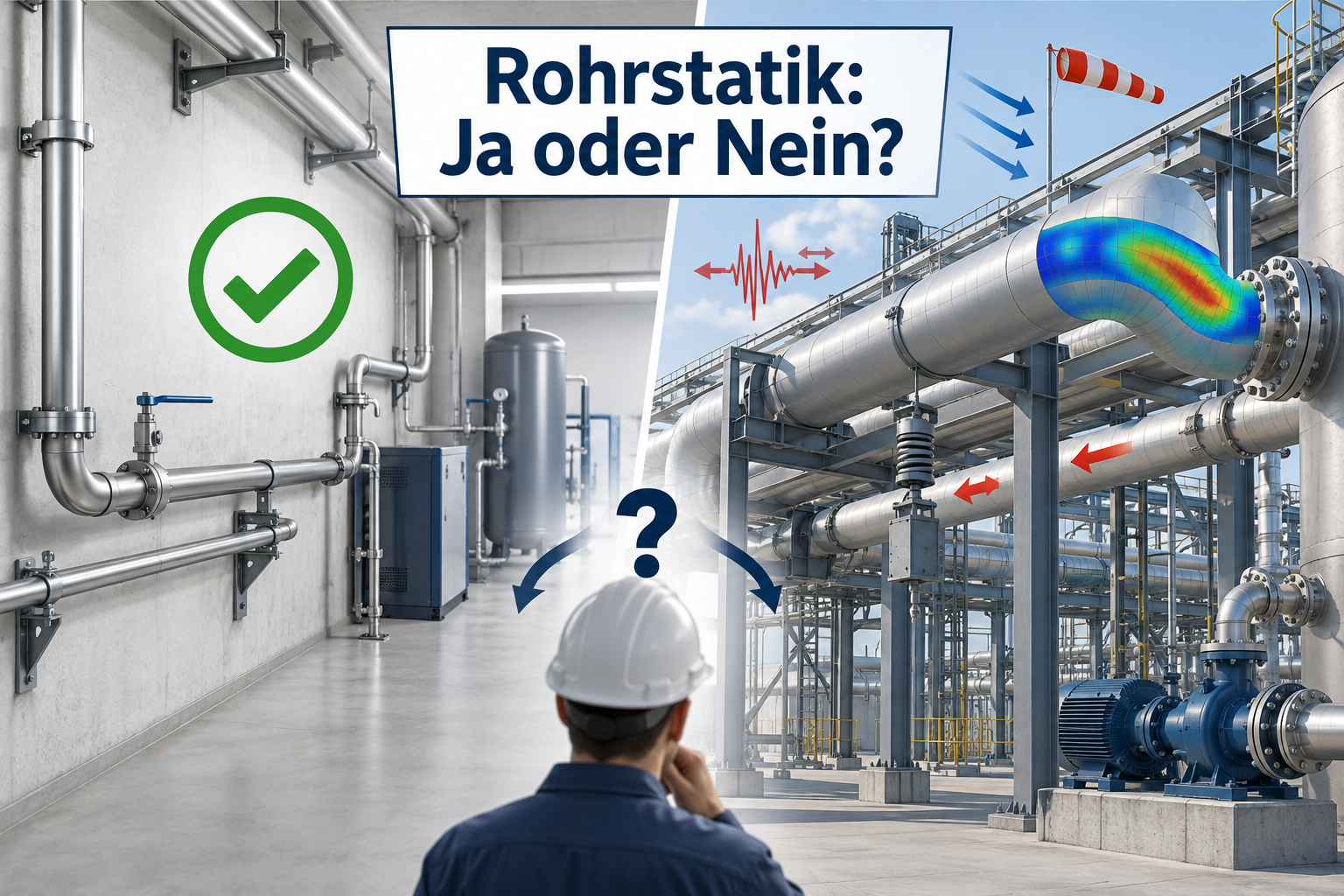
Does every pipe have to be verified by a pipe stress analysis? In practice the answer is: no. For simple and proven piping systems, design in accordance with recognised good engineering practice – internationally often summarised under the term RAGAGEP (Recognized and Generally Accepted Good Engineering Practices) – can be sufficient. With increasing temperature, pipe size, support spacing or complexity, however, the behaviour of a pipe becomes increasingly difficult to assess from experience alone. At the latest when several influences are superimposed or allowable loads at pumps, equipment or supports have to be verified, a pipe stress analysis offers considerable advantages.

Author
Dr.-Ing. Philipp Schwittek
Reading time
5 minutes
Updated
18. September 2026
Pipe stress analysis? Good engineering practice?
The key points
  • Not every pipe needs a full pipe stress analysis.
  • Simple, short and proven systems can often be designed in accordance with good engineering practice.
  • Thermal expansion, large support spacings, wind and earthquake increasingly argue for a calculation of the system as a whole.
  • Large nominal sizes and heavy or heavily insulated pipes increase the mechanical loading.
  • A pipe stress analysis is particularly useful for determining pump and equipment nozzle loads.
  • Small nominal sizes can be critical too – for example at high temperatures, with thick insulation or at sensitive connections.
  • A pipe stress analysis not only provides a verification but also creates transparent technical documentation.
  • It supports coordination between piping design, structural steelwork, equipment design, client and operator.
  • An independent check of the calculation implements the four-eyes principle at the same time.
01

When can good engineering practice be sufficient?

A full pipe stress analysis is not necessarily required, particularly for simple and easily understood piping systems.

Typical examples are: short pipes inside buildings,
small to medium nominal sizes, fluids of low density such as air or nitrogen, small temperature differences between installation and operation, low external loads, proven pipe supports, defined and sufficiently small support spacings, no sensitive pump or equipment connections.

Piping on pipe racks can also be built without a detailed pipe stress analysis if, for example, support spacings are standardised, piping classes are known and thermal loading is low.

“Good engineering practice” by no means implies design without technical consideration. Support span tables, simple strength calculations, manufacturers’ specifications, codes and standards and proven design details can constitute suitable verification for such systems.

What matters is that it can be assessed transparently why no further system calculation is required.

02

When is a pipe stress analysis particularly useful?

The more a pipe is influenced by external loads or imposed movements, the more difficult a reliable assessment based on experience alone becomes.

Thermal expansion

Changes in temperature lead to changes in the length of the pipe. If these movements are restrained by anchors, guides, friction or equipment connections, forces and moments arise.

Particularly with: long pipes, steam and hot water lines, high operating temperatures, low temperatures, frequently changing operating conditions, a pipe stress analysis is therefore useful.

Wind and earthquake

On outdoor piping, wind loads can cause considerable lateral forces. They become more critical in particular with: large nominal sizes, large support spacings, high pipe racks, thick insulation, free-standing lines.

It is not only the nominal pipe size itself that must be considered. A heavily insulated small pipe can present a surprisingly large area to the wind because of its much larger outside diameter.

Trace heating can also play an indirect role, since it influences the governing pipe temperature and thus the thermal expansion.

For seismic loading, consideration should always be given to how the dynamic loads are transferred via the pipe, supports and anchors into the supporting structure.

Large support spacings, heavy lines and large nominal sizes

As the distance between two pipe supports increases, bending moments and deflections rise.

Relevant here are not only pipe diameter and wall thickness but also, for example: weight of the fluid, valves, insulation, attachments, concentrated loads.

On large-diameter piping, local deformations of the pipe wall can additionally become relevant and may require a more detailed finite element analysis.

03

Nozzle loads and documentation – why a pipe stress analysis is often useful all the same

A particularly important reason for a pipe stress analysis is determining the forces and moments at connected components.

Typical interfaces are: pumps, compressors, vessels, heat exchangers, columns, valves, special equipment.

The nozzle loads occurring there result from the interaction of the entire system. Dead weight, thermal expansion, friction at pipe supports, anchors and external loads can reinforce or reduce one another.

A pipe stress analysis makes it possible to determine these forces unambiguously and to compare them with allowable values from manufacturers or codes.

More than just a strength verification

Even if a pipe could theoretically be designed in accordance with proven engineering practice, a pipe stress analysis can make sense from a project point of view.

A calculation report documents, for example: design basis, temperatures and pressures, load cases, support concept, anchors and guides, displacements, support loads, nozzle loads,

stress verifications.

This produces a transparent technical document for client, operator, structural steelwork and equipment manufacturer.

Particularly on larger projects this is an important mark of quality. Design and calculation can be checked independently of each other and thus support the four-eyes principle.

Frequently asked questions

Frequently asked questions about Pipe stress analysis or good engineering practice (RAGAGEP)?

Does a pipe stress analysis have to be carried out for every pipe?

No. For simple, short and mechanically uncritical pipes, design in accordance with proven engineering practice can be sufficient. What matters are the actual operating conditions and loads.

Is there a nominal size above which a pipe stress analysis is always required?

A generally valid DN limit makes little sense. A long DN 25 line at high temperature with a sensitive pump connection can be mechanically more demanding than a short DN 500 line at close to ambient temperature.

At what temperature should a pipe stress analysis be carried out?

It is not the absolute temperature alone that matters but the temperature difference from the installed condition, the pipe length and the ability of the line to expand freely. The more thermal movements are restrained, the more important a flexibility analysis becomes.

Is a pipe stress analysis always required for piping on pipe racks?

No. With standardised pipe racks, known support spacings and low thermal loading, design in accordance with proven engineering practice can be sufficient. Long hot pipes or lines with large anchor forces, on the other hand, should be examined as a complete system.

Is wind relevant for small pipes?

The pipe diameter alone is not always the governing factor. Thick insulation can considerably increase the area exposed to the wind, so that relevant wind loads can arise even with smaller nominal sizes.

Why is a pipe stress analysis useful for nozzle loads?

The forces at an equipment or pump connection depend on the behaviour of the entire piping system. A pipe stress analysis makes it possible to determine and document these forces and moments under the various operating conditions.

Can a pipe stress analysis be worthwhile even if it is not strictly required?

Yes. It documents assumptions, load cases, supports, displacements and connection loads and makes coordination between the disciplines involved easier. Towards clients and plant operators in particular, a transparent calculation report creates additional clarity.

What does RAGAGEP mean?

RAGAGEP stands for Recognized and Generally Accepted Good Engineering Practices. It refers to recognised and generally accepted engineering procedures that can be derived, for example, from codes, standards, manufacturers’ recommendations and proven technical standards.

About the author

Dr.-Ing. Philipp Schwittek

Managing Director, Entracon Planungsgesellschaft mbH

Engineer with a doctorate, specialising in plant engineering, digital design and process automation – from simulation through to commissioning.

  • Sizing
  • Design
  • Plant engineering
  • Standards and safety
Contact

Still a question open?

A short conversation usually settles more than three quotations. You reach an engineer directly, not a queue.

Reach Entracon

How can we help?

Chat is not staffed right now. We are back for you tomorrow from 08:00. Just request a call-back – we'll get back to you.
Send an e-mail info@entracon.de
Or call us directly +49 234 5414010