


Lifting aids

Lifting aids for logistics and warehousing: many picks, little time.

In a warehouse, a single item is rarely too heavy. It is the total: hundreds of picks per shift, changing formats, pallets at every height. A lifting aid for logistics therefore has to be one thing above all – as fast as the hand.

Equipment
5
Use cases
4
Makes
all
01

In logistics, the total is what counts

Production and assembly usually involve one heavy part and a fixed sequence. Warehouse logistics is the opposite: individual goods are often easy to lift, but there are many of them and no two are alike. The Key Indicator Method reflects exactly that – frequency counts in the rating just as weight does. A workstation with medium-weight cartons can therefore score higher than one where a heavy part is lifted twice a day.

For the lifting aid this means one strict requirement: it must not lengthen the pick. Every extra second per pick adds up over a shift to time that is missing in dispatch. Lifting aids for logistics are therefore chosen for speed first and for capacity second.

02

Goods-in, order picking, dispatch

The three areas pose different tasks, even when the same goods pass through them. At goods-in, pallets are broken down: mixed layers, unknown weights, film and strapping. This needs a gripper that can handle a lot and a lifting range from the floor to the top layer.

In order picking, the method matters. With goods-to-person picking, the lifting aid is fixed at the picking station and serves a small area at high frequency. With person-to-goods picking, a fixed lifting aid rarely makes sense – mobile units at the locations with heavy goods are usually the better answer.

In dispatch, goods are packed and loaded pallet by pallet. There the area decides: packing table, roller conveyor and pallet space should all lie under one supporting structure.

03

The structure has to fit the warehouse

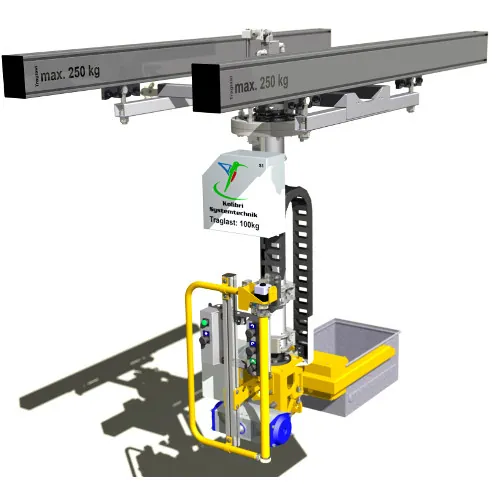
A jib crane covers a circle around its column, a rail system a rectangle. In logistics the rectangle is usually the better shape, because conveyors, packing tables and pallet spaces stand in rows. A rail system can be fixed to the hall ceiling, to existing columns or to its own steel structure; what the ceiling can carry has to be checked beforehand.

Lifting aids in a warehouse have a neighbour that production sees less often: the forklift. Where industrial trucks cross, columns need protection and structures must hang high enough for a mast to pass beneath. We settle these questions during the site survey, not during installation.

04

One gripper for a changing range

If only one format is lifted, the gripper is built for that format. In logistics that is the exception. A vacuum area gripper with separately switchable zones picks cartons of different sizes without anyone having to change anything. For sacks, buckets or containers that no suction pad holds, there are interchangeable grippers with quick couplings.

It pays to sort the range first: which formats account for most of the picks, which are exceptions? The gripper is built for the majority. The exceptions get a second gripper or deliberately remain manual work – if the risk assessment allows it.

05

Multi-shift operation uses up service life

Many short cycles load a hoist differently from a few long ones. In the multi-shift operation of a distribution centre, the theoretical service life of a device is therefore used up faster than its year of manufacture suggests. That affects maintenance: intervals should follow the actual number of cycles, not just the calendar. Our calculator estimates, by the method of FEM 9.755, how much service life a hoist has already consumed.

06

Mobile where the location changes

Not all heavy goods arrive at a fixed place. For changing locations – an aisle with heavy items, a ramp used only at times – there are lifting aids on a wheeled base. They need a level floor with sufficient load-bearing capacity and a design that remains stable with the arm extended. Whether a mobile solution will do or a fixed station pays off is usually shown by the number of picks per day.

Overview

Lifting aids in logistics by area

Area Typical goods Bottleneck Obvious solution
Goods-in Mixed pallets, containers Changing formats, layer height Lifting column or balancer with interchangeable gripper
Picking (goods to person) Cartons, totes Frequency at a fixed station Rope balancer with area gripper, small rail system
Picking (person to goods) Heavy single items Changing location Mobile unit at the heavy spots
Dispatch Cartons, parcels Area from packing table to pallet Rail system over the whole packing station
Returns Unknown contents Weight and centre of gravity unclear Gripper with reserve, slower movement
Frequently asked questions

Frequently asked questions about Logistics and warehousing

Is a lifting aid not too slow for logistics?

If it is the wrong one, yes. A rope balancer with a suitable suction gripper grips and lifts in one movement; the operator has nothing to hook on and nothing to wait for. What matters is that gripper and controls are matched to the most frequent formats.

Can a lifting aid be fixed to the hall ceiling?

Often, but not always. Whether the roof or ceiling can take the additional loads has to be checked first. Where it cannot, the rail system stands on its own steel structure or on existing columns.

What about forklift traffic under the rail system?

The structure has to hang high enough for mast and load to pass beneath, and columns in the driving area need impact protection. We include the traffic routes in the planning.

Can different carton sizes be lifted with one gripper?

With an area gripper whose zones can be switched individually, in many cases yes. For goods that no suction pad holds, there are interchangeable grippers with quick couplings.

How often does a lifting aid need maintenance in multi-shift operation?

That depends on the manufacturer’s instructions and actual use, not on the calendar alone. With many cycles per shift, shorter intervals are usual. The periodic inspection is separate and is set in the risk assessment.

Contact

Describe the load and the task to us.

Weight, dimensions, gripping point and how often a day – that is all a first proposal needs. The rest we settle at the workstation.

Reach Entracon

How can we help?

Chat is not staffed right now. We are back for you today from 08:00. Just request a call-back – we'll get back to you.
Send an e-mail info@entracon.de
Or call us directly +49 234 5414010