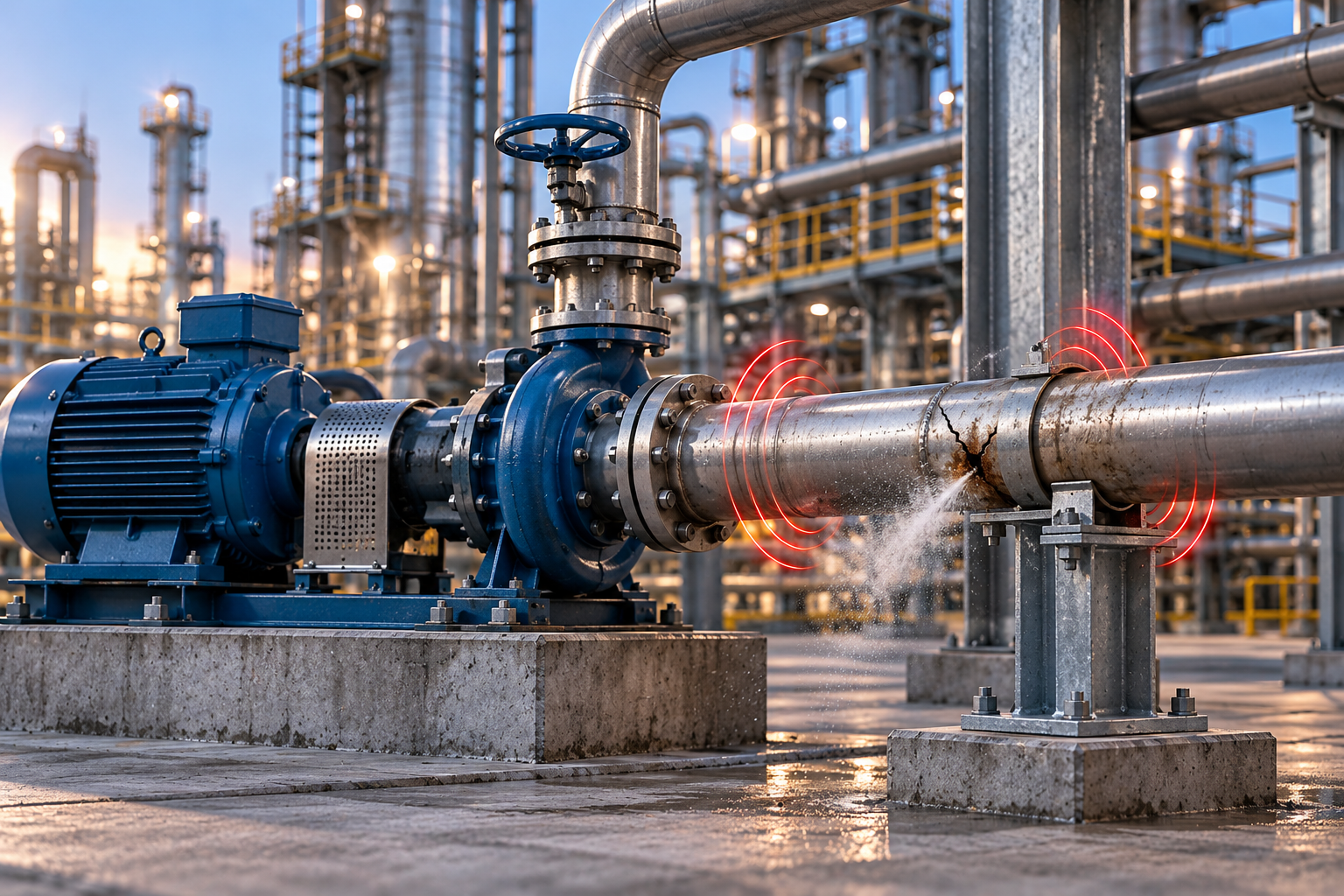
Before any design change, it should be clarified under which conditions the vibration occurs: permanently or only during start-up, at a particular speed, after a valve movement or only at a particular throughput?
For the investigation, it is not only visible deflections that are of interest. Depending on the task, vibration velocity, acceleration or strain are recorded and matched with the operating condition. By combining measured data and calculation model, the loading of critical connection areas can be assessed more precisely.
In the case of new, severe vibration, lines that are hammering, visible damage or leaks, the safe assessment of the operating condition takes priority first. Changes should not be made by improvised clamping or uncontrolled operating trials.
Our approach is to examine first whether an improvement at the cause is possible.
With pressure surges, for example, adapted switching sequences or suitable valve closing characteristics can be part of a solution. Which measure is suitable depends on the hydraulic system as a whole; a sequence that is merely slower or faster is not automatically right.
If the excitation arises at a control valve, its selection and operating conditions should be examined. With large pressure drops, valve trims and pressure reduction concepts designed for the purpose may be required. Cavitation or flow-induced excitation cannot be reliably remedied by fixing the downstream pipe more firmly.
On steam lines, by contrast, slope, drainage and condensate removal are possible starting points. An additional support does not eliminate a condensate accumulation.
A change in the mode of operation can be the simplest solution – but it is only suitable if process requirements, permissible operating ranges and safety functions continue to be met. Settings on safety devices are not parameters that may be freely changed for optimisation.
If the excitation cannot be reduced sufficiently, modifying the supports comes into consideration. This can include additional supports, shorter unsupported pipe sections or a stiffer connecting structure.
It is not enough to consider the pipe clamp alone: an effective support also needs a sufficiently stiff load path into the load-bearing steelwork or the building. The position of the support must suit the governing mode of vibration.
At the same time the thermal movement required must be preserved. A suitable support can, for example, control one direction of movement without preventing all longitudinal displacement. Manufacturers also offer pipe supports specifically matched to thermal sliding and vibration limitation for this purpose.
More stiffness is one possible measure but not an end in itself. It must be checked whether the dynamic response improves and which additional forces arise in the hot operating condition.
Dampers act at a different point: they extract energy from the vibrating system.
Viscoelastic pipe dampers convert kinetic energy into heat and can thereby reduce resonant vibration in particular. For selection, travel, frequency range, temperature and the connection to a suitable abutment, among other things, are decisive. The dampers described do not replace a static weight support.
A distinction must be made between these and shock arrestors, or snubbers. These permit slow thermal movements with little resistance and provide an approximately rigid connection during rapid movements. They thus serve above all to limit dynamic events; their suitability for the specific loading must be checked separately.
Springing and damping are not the same thing either. An elastic element first of all changes the support characteristics. Whether effective vibration reduction is achieved with it depends on how it is tuned to the system.
A dynamic investigation should suit the question being asked. The natural frequency analysis alone does not yet provide actual operating vibrations or dynamic stresses. For that, excitation, damping and boundary conditions must also be taken into account.
Besides static analysis, ROHR2 offers, among other things, the calculation of natural frequencies and mode shapes and investigations with harmonic or time-dependent excitation. This allows suitable models to be built for assessing dynamic loads.
For high-frequency local pipe wall vibration, however, a different approach is required than for the bending vibration of an entire pipe section. An additional guide is therefore not the appropriate answer to every vibration mechanism.
After implementation, the effect should be checked under comparable operating conditions.