

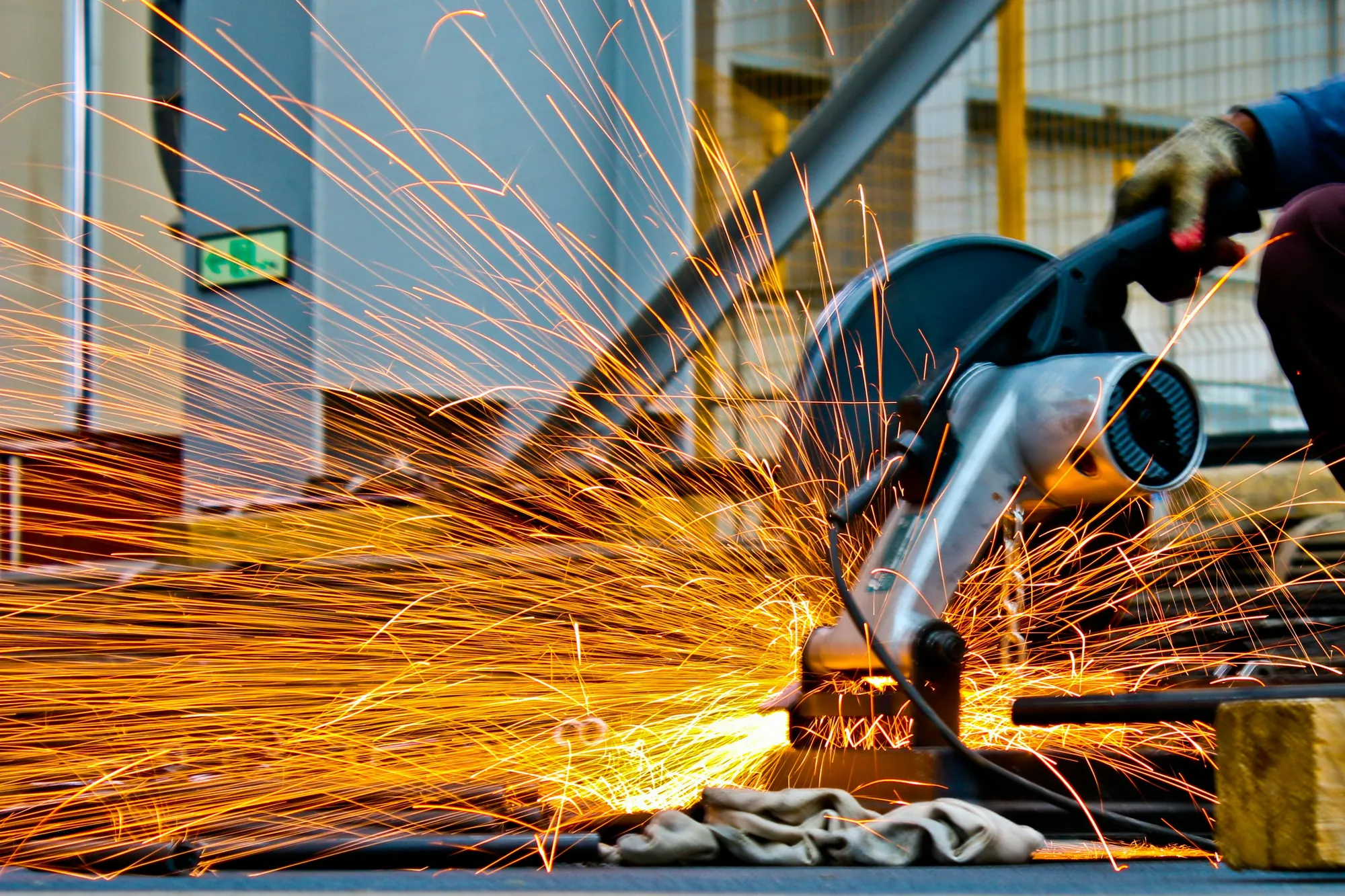
Machine loading
Place cast, forged and sawn blanks into lathes, mills and machining centres – deep into the working area and behind the guard door.
 rapidFOX
Sustainability
Company
Get in touch
rapidFOX
Sustainability
Company
Get in touch
In machining, value is created in the spindle, not on the way to it. Even so, a considerable share of setup time goes into loading, turning and unloading heavy blanks – often on the shop crane, often with two people. A manipulator at the machine turns that into a one-person movement of a few seconds.
Typical handling tasks in Metal & machinery — and what they demand technically.
Place cast, forged and sawn blanks into lathes, mills and machining centres – deep into the working area and behind the guard door.
Rotate parts between two clampings without setting them down. The balancer holds, the operator turns.
Exchange heavy fixtures and chuck jaws during setup – the most common place for crushing injuries at the machine.
Guide large, unwieldy assemblies into the welding fixture and hold them in position until the tack weld holds.
Move chip bins, part baskets and washing baskets between machine, washer and measuring station.
Load and unload blanks and drawn parts without reaching into the press area.
Not to buy – to run. Working on a crane means waiting: for the trolley, for a colleague, for the load to stop swinging. A pick-up that takes eight seconds on a manipulator easily costs three minutes on a crane, because slinging, travelling, aligning and setting down all add up. At twenty changes a shift that is an hour of machine downtime per day and station. A manipulator stands at the machine, is ready without slings and does not swing.
When loading a fixture, the last centimetre decides. A rope balancer that keeps swinging turns loading into searching. Our units are damped through the control so that the load stays where it is released. That spares not only the operator’s nerves but above all the mating faces of the fixture.
A machining centre has a guard door, a chip conveyor and usually a control pedestal in the way. A pillar-mounted jib arm cannot get around obstacles like that – a two-section articulated arm folds around them and reaches positions hidden on a straight line. That is why articulated units predominate in machining.
A manipulator transfers its tilting moment into the shop floor. At 125 kg over 3.4 m of reach that is more than four kilonewton metres at the base. Before any sizing we therefore check whether the unit will be bolted, anchored or set on a mobile base plate – and we calculate the anchor forces. That is part of the design, not of the installation.
Design, payload and reach — the shortlist for this industry.
The jointed arm for millimetre-precise handling.
View deviceArticulated reach meets weightless floating.
View deviceThe jointed boom with a wide radius.
View deviceMobile lifting axis for flexible lifting.
View deviceCAD design in 2D and 3D – from requirements analysis to production-ready drawings.
ViewLoad, reach, cycle time – plus grippers for anything without a catalogue entry.
ViewLifting equipment, manipulators and balancers for industry, medical technology and logistics.
ViewRecurring inspection of your equipment to German accident prevention regulations.
ViewUsually yes. The crane serves the whole shop, the manipulator serves one station – and that is where seconds count. Count the change frequency: from around ten movements per shift at one station, the fixed unit is more economical because there is no waiting for the crane.
Yes. We supply coolant-resistant versions with encapsulated bearings and protected energy supply. For aggressive media or cleaning processes there are additional coated versions.
Usually not. A load-bearing industrial floor is normally sufficient – the pillar is anchored or bolted. We calculate the anchor forces from payload and reach and tell you before you order whether your floor carries them. Where drilling is not possible we use a ballasted mobile base plate.
Yes – via a rail system or a mobile unit on a base plate. Beyond two machines the rail almost always pays off, because it guides the path and the unit does not have to be realigned every time.
It is not the weight that forces two people. It is the area.
Read the case ApplicationThe torque goes into the arm – or into the person.
Read the case ApplicationGlass does not forgive a second attempt.
Read the case ApplicationSix metres of steel is not a weight. It is a lever.
Read the caseOne short conversation usually settles more than three quotations. Call or write — you will reach an engineer directly.
Start typing – for example “balancer”, “SAP” or “pipe stress”.
Reach Entracon
How can we help?
Thank you.